
Artist Colonies and Impressionism by the sea
The artist colonies of late nineteenth and early twentieth-century Britain grew in places where the modern world seemed, at first glance, to fall away: among fishing coves, harbour steps, whitewashed lanes, rural rooms and wind-cleared stretches of coast. Their appeal lay partly in the survival of older forms of labour and acts that carried the weight of continuity: the mending of nets, the gathering of crops, the waiting at windows and quaysides for those at sea. But these colonies were shaped just as much by movement as by stillness. With the railways came artists with continental training to these margins, who carried their images back into the centre of an art world governed by stuffy London art schools and exhibition hierarchies. To understand them only as picturesque retreats is to miss their deeper significance. They were threshold spaces, where painters could observe a traditional world not outside modernity, but caught in the light of its arrival..

British Impressionism and rural naturalism developed with particular force by the sea. Impressionism in Britain came… quite literally via the coast, finding its most distinctive settings in communities stretching from Kirkcudbright and Staithes in the North, and Newlyn and St Ives in the South. These places seemed to offer artists a world “frozen in the past,” defined by ordinary labour, unindustrialised landscape and the “clarity of the light and air” absent from metropolitan centres. Yet this apparent timelessness was itself a modern construction. Artists arrived through networks of railways, art schools, continental ateliers, galleries and exhibitions. The colony was therefore both a site of preservation and a product of mobility.

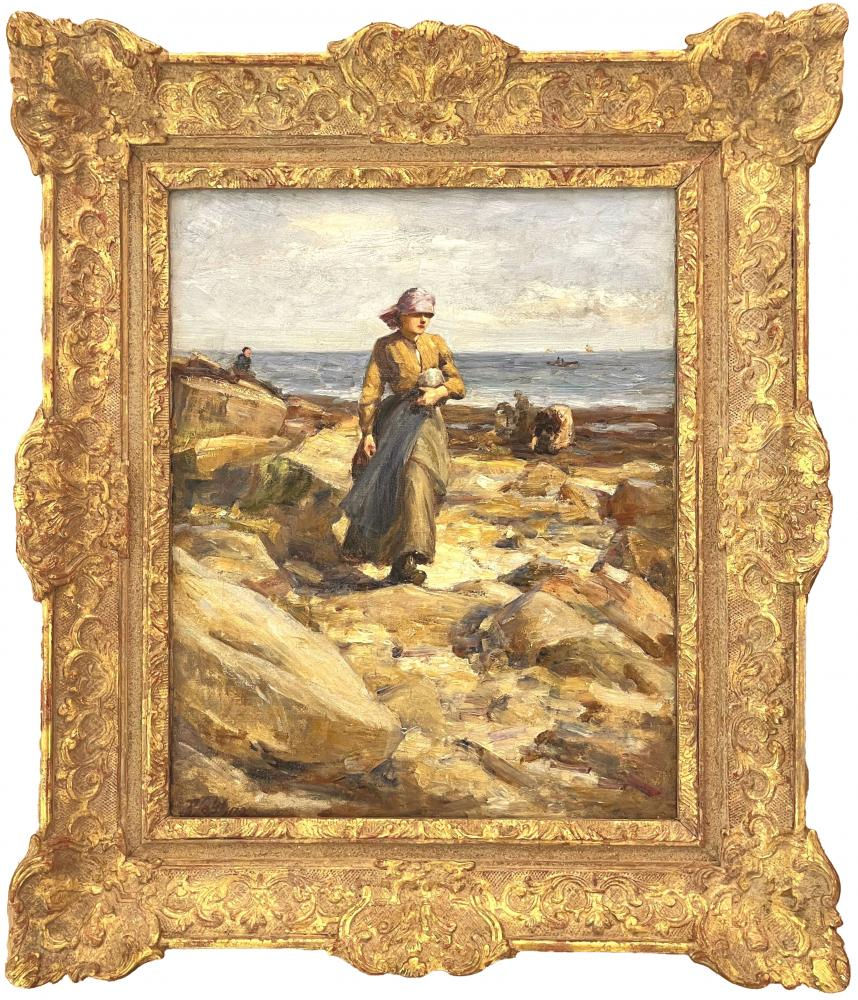
The Scottish artists Edward Atkinson Hornel and Robert Gemmell Hutchison represent an important northern dimension of this phenomenon. Their work suggests that the artist colony was not governed by a single visual language. Hornel’s decorative intensity, with its emphasis on pattern, surface and enclosed natural settings, transforms the rural or coastal environment into a symbolic field. Hutchison, by contrast, often approached childhood, domesticity and shoreline life through a softer naturalism, investing everyday subjects with emotional restraint. Together, they show how the Scottish colony could operate as a place of memory and inwardness as much as direct social observation.
The Staithes and Cullercoats artists developed a more explicitly social and regional naturalism. Robert Jobling, closely associated with Cullercoats, brought particular authority to the representation of fishing communities. His formation as both worker and artist is central to the meaning of his work. He studied in the evenings while employed by the Tyne General Ferry Company, and his artistic world was shaped by a local culture in which labour could be raised up to a position of reverence. In his depictions of fisherfolk, boats and coastal labour, the working body is not decorative but the ethical centre of the picture.
Ralph Hedley belongs to this same northern realist context, though his subject matter often extends beyond the shore into domestic interiors, workshops and urban working-class life. His relevance to the artist-colony tradition lies in his sustained attention to ordinary labour and local identity. Like Jobling, Hedley resisted the abstraction of the ‘common person’ into sentiment. Instead, he treated work, age, childhood and community as serious pictorial subjects. His realism helps connect the coastal colonies to a broader northern culture of social observation.
Ernest Rigg introduces another important dimension: the return of continental training to regional subject matter. Born in Bradford and trained at the Académie Julian in Paris, Rigg brought the techniques and assumptions of plein-air painting back to Yorkshire. He belonged to a later wave of artists drawn to Staithes, after the railway’s arrival in 1883 had opened the village more fully to outside visitors. His paintings of turnip pickers, village gardens and rural labour demonstrate how international artistic methods could be absorbed into a local visual culture without dissolving its particularity.

Staithes itself is crucial to this argument because it embodied the paradox of the artist colony. Before the railway, the village had been relatively inaccessible; after 1883, it became newly available to painters seeking forms of life that appeared untouched by modern industrial change. The village had “largely avoided” the transformations affecting Tynemouth and the Shields, preserving a traditional existence within a harbour “sheltered… from the rest of the world.” Yet the very act of painting Staithes depended on the modern systems that connected it to the wider world.

The younger Staithes artists Dame Laura Knight and Harold Knight provide the clearest link between Staithes and Newlyn. Laura Knight’s early years in Staithes trained her in careful observation, developed through close study of children, fisherfolk, nets, fish and village rituals. This observational discipline became foundational to her later career. Staithes also appealed because of its obvious similarities to Newlyn making the Knights’ later movement toward Cornwall a transfer of artistic method rather than a simple change of location. Their careers demonstrate that the colonies formed an interconnected network through which artists, techniques and social concerns circulated.
The Newlyn School had already established the most influential model for this kind of socially engaged coastal painting. Walter Langley approached the fishing community through scenes of waiting, age, hardship and domestic endurance. His work is notable for its moral seriousness and emotional restraint. Rather than dramatise poverty, he gave pictorial dignity to forms of labour and loss often excluded from academic art. Stanhope Alexander Forbes, often identified as the central figure of the Newlyn School, expanded this realism into large-scale public composition. His village scenes present community life as social theatre, where religion, class, labour and childhood converge in carefully structured open-air settings. He made Newlyn visible not merely as a picturesque fishing village but as a modern artistic centre capable of sustaining ambitious figure painting.

Henry Scott Tuke widened the Cornish field in another direction. His maritime paintings, especially those associated with Falmouth, transform boats, water and the human figure into studies of light, atmosphere and bodily freedom. Charles Walter Simpson further extended the colony’s concerns through his treatment of landscape, animals and rural life, linking Newlyn naturalism to a broader modern pastoral.
The connection between these artists and colonies is therefore not reducible to style. Hornel, Hutchison, Jobling, Rigg, Hedley, Laura Knight, Harold Knight, Langley, Tuke, Forbes, and Simpson worked in different registers, from decorative symbolism to social realism and luminous plein air painting. What joins them is their shared attention to places in transition. Each colony stood between older communal structures and the modern systems that made those structures newly visible. The railway, the harbour, the exhibition wall and the art school were all part of the same historical process.

The artist colony should consequently be understood as one of the central institutions of British modernity. It enabled artists to represent forms of labour, locality and social life that seemed endangered by industrial change, while also participating in the very networks of modern circulation that threatened to transform them. The fisherman, the turnip picker, the child on the shore, the woman at the window, the bather and the net-mender are not figures outside history. They occupy its edge: the threshold where tradition becomes image, and where modern British painting finds one of its most distinctive forms.
A fully illustrated catalogue for CURATED can be viewed below.
All works are available to buy online and from our gallery in St. James's


Comments